News and Events - May 2011
NEWS AND EVENTS - Tuesday, May 31, 2011
COMMUNIQUE
FROM THE HOLY ASSEMBLY OF BISHOPS OF THE SERBIAN ORTHODOX CHURCH
HELD IN BELGRADE MAY 16- 27, 2011
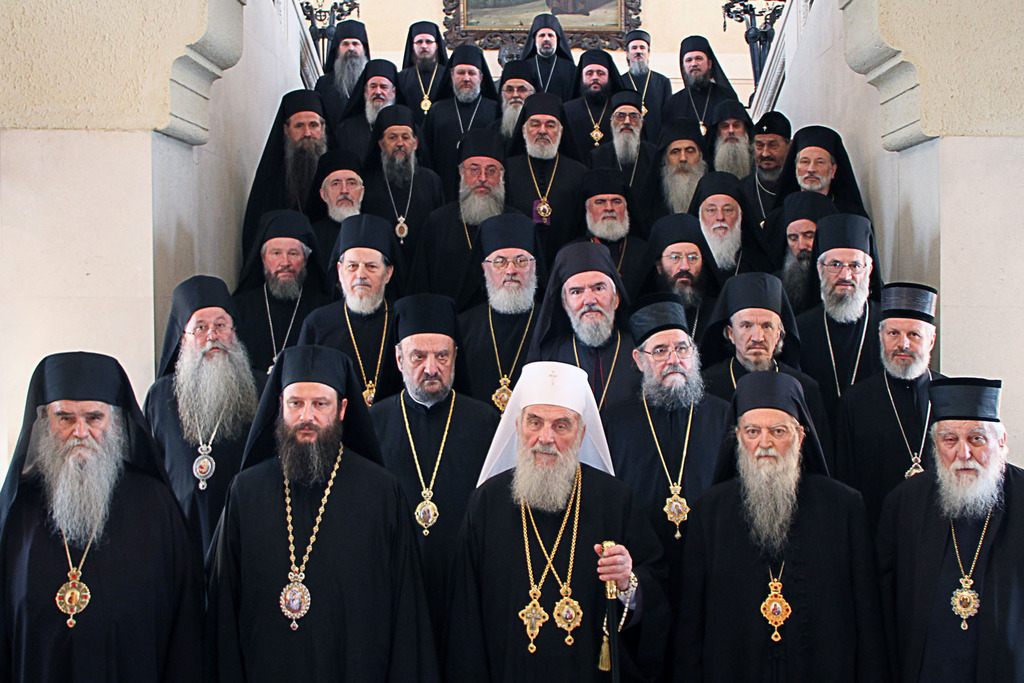
The regular meeting of the Assembly of Bishops of the Serbian Orthodox Church took place at the Serbian Patriarchate in Belgrade May 16-27, under the presidency of His Holiness Serbian Patriarch Irinej. Participating in the Assembly were all the diocesan hierarchs of the Serbian Orthodox Church, as well as of the autonomous Archbishopric of Ochrid headed by His Beatitude Archbishop of Ochrid and Metropolitan of Skopje, Jovan.
The Assembly began its work with the joint serving of the hierarchical Divine Liturgy in the Holy Archangel Michael Cathedral in Belgrade, led by Serbian Patriarch Irinej, and served the Invocation of the Holy Spirit, the Spirit of truth and wisdom, in Whom the Church lives and always works, especially in the assemblies of its bishops. Then the president of the Assembly, His Holiness the Patriarch, in his opening statement to the Assembly indicated some of the current questions of the life and mission of the Church in these times, times of difficult trials for us and for the world, but also times of hope and spiritual action.
During this year’s Assembly the joint celebration of the Liturgy took place twice—on the feast of the transfer of the relics of our Holy Father Nicholas on May 9/22 in Sremski Karlovci on the patronal feast of the completely renovated Cathedral church of St. Nicholas, and in Belgrade’s church of the Holy Apostle and Evangelist Mark on the feast of the Holy Brothers Cyril and Methodius, Enlighteners and Teachers of the Slavs, on May 11/24. The most important decision of the Assembly concerns the liturgical life of the Church — the establishment of the feast of the wonderworking Icon of the Most Holy Theotokos kept at the Patriarchate of Pec, to be celebrated every year on the day after the feast of the Ascension of our Lord. From this time this feast loses its local and takes on an all-church character. Beginning with its most important liturgical aspect, the Assembly concerned itself with the upcoming celebration of the 1700th anniversary of the Edict of Milan (313-2013) in Nis, the birthplace of St. Constantine the Great, on the local, pan-Orthodox, and all-Christian levels. The Assembly also sent a letter to His Holiness Ecumenical Patriarch Bartholomew about the earliest possible calling of the Holy and Great Council of the Orthodox Church — naturally, after all necessary preparations, with deep accountability and in the spirit of complete faithfulness to the holy ecumenical and local councils of the past.
Having heard the report of the Holy Synod on its activities in the period just ended and the reports of the diocesan hierarchs, the Assembly made appropriate decisions.
At the meeting of the central body for the completion of the Church of St. Sava on Vracar, the Assembly welcomed with warm thanks the brotherly willingness of the Russian Orthodox Church and the great Russian state to help with the interior appointments of the church, and after the meeting a memorial service was held for the founders, benefactors and donors of the church.
The reorganization and restructuring of certain dioceses in Serbia, in Europe and in America and Australia was carried out, and most episcopal vacancies were filled, although some dioceses continue to be guided by bishop administrators. As bishop of the vacant see of the Diocese of Nis was elected the heretofore vicar bishop to the Metropolitan of Montenegro and the Coastlands and elder of Monastery Ostrog, the Bishop of Dioclia Dr. Jovan, and as bishop of the newly created Diocese of Krusevac Hierodeacon Dr. David (Perovic), assistant professor at the Theological Faculty of Belgrade University. The administrator of the newly formed Diocese of Austria and Switzerland with its see in Vienna will be the Bishop of Backa Dr. Irinej, and Metropolitan Dr. Amphilohije of Montenegro and the Coastlands will serve as administrator of the newly created Diocese of Buenos Aires, which will be comprised of all the congregations and missionary parishes in South and Central America. Elected as vicar bishops to His Holiness the Patriarch were Protosyngel Jovan (Culibrk) with the title Bishop of Diplja, and Archmandrite Andrej (Cilerdzic) with the title Bishop of Remezija. Likewise, the Assembly asked Bishop Grigorije of Zahum-Hercegovina to assist Metropolitan Nikolaj of Dabro-Bosnia in carrying out his archpastoral duties as his deputy.
On the American continent, as the result of restructuring, the Diocese of New Gracanica-Midwest America was created, while the Metropolitanate of Libertyville-Chicago ceases to exist. The Assembly decided that St. Sava Monastery in Libertyville, near Chicago, will attain the status of a stavropigeal institution, that is, a monastery directly under the jurisdiction of the Serbian Patriarch. New York-Washington was designated as the new see of the Eastern American Diocese. The revised Statute of the Canadian Diocese was approved, as was the Constitution of the Metropolitanate of Australia and New Zealand.
The creation of new dioceses from the Archdiocese of Belgrade-Karlovci was for the present postponed. Likewise, while aware of the obvious pastoral reasons for the reestablishment of the ancient Diocese of Ras, absorbed by the Diocese of Prizren during the difficult time of the Turkish enslavement, and that the permanent presence of a bishop in the Ras region would strengthen the visible and active presence of the Serbian Orthodox Church in that part of Serbia, the Assembly temporarily postponed the resolution of this question until all necessary conditions are met.
With the aim of ensuring the most effective organization of church life, the Assembly enlarged the existing Assembly commission for the revision of the Constitution of the Serbian Orthodox Church.
As it does every year, the Assembly gave full attention to church education in general and church schooling in particular. The Orthodox Theological Faculty of Belgrade University has been entrusted with a very important mission—the translation of the works of the holy Fathers and Teachers of the Church from the original languages and their publication with accompanying scholarly introductions and commentaries. Further, the Assembly expects the advancement of cooperation between the Serbian Orthodox Church’s institutions of higher learning. Protopresbyter Professor Jovan Petkovic was elected the new dean of the Seminary in Karlovci, and it was decided to resume the work of the Prizren seminary in Prizren itself, while part of its activities will continue in Nis. The Assembly recommended steps for the advancement of the educational system in the seminaries of the Serbian Orthodox Church and steps for the introduction of theology into the educational system of Serbia on Serbian territory, and recommended the establishment of Orthodox high schools and other schools which would work under the jurisdiction of the Church, wherever that is possible.
The Assembly welcomed the return of religious services to the Serbian Army, as well as the decision of the Constitutional Court of Serbia on the constitutionality of the law on the return of illegally seized properties of the Church and religious organizations. In this regard, the Assembly awaits and seeks the implementation of the provisions of this law, which has not yet been implemented even though it is valid and obligatory, which is unacceptable.
The Assembly welcomes the decision of the Serbian state authorities to return the Church’s metrical books, which were confiscated after the Second World War, and hopes for the return also of bequests and donor funds which have not yet been returned. Expecting and seeking the complete return of expropriated church property, the Assembly also supports the return to all organizations and foundations of properties illegally confiscated from them. The Assembly regrets that the neighboring Republic of Hungary refuses to return the former church building in Budapest’s Baca Street to the Diocese of Budim.
Similarly, the Assembly regrets that there has occurred a deep crisis in relations between the Patriarchate of Jerusalem, the oldest Christian Church, and the Romanian Orthodox Church, because of the uncanonical activities of the latter in the Holy Land. Sadly, neither does the hierarchy of the Romanian Orthodox Church respect the canonical order and jurisdiction of the sister Churches in other places. In our case, the Assembly is grateful to the Romanian Orthodox Church for its good relationship towards the Serbian Orthodox Church’s Diocese of Temisvar and for the support it offers to its administrator, clergy and monastics, which reciprocates the Serbian Orthodox Church’s stance of brotherly love towards the Romanians in Serbian Banat, but at the same time it expresses its regret and energetic protest concerning the uncanonical intrusion of certain bishops and clergy from Romania in the territory of two dioceses in eastern Serbia, without the approval of the ruling bishops from the Serbian Orthodox Church. If the noncanonical and unbrotherly actions of these individuals do not end, the Assembly and Synod of the Serbian Orthodox Church will take all canonical and legal steps to stop them, to protect the established canonical order, and to prevent the disturbance of the sacred inter-Orthodox unity, whoever may be the instigator and organizer of the activities which endanger that unity.
The Assembly also deeply regrets that the government of the Republic of Macedonia, despite criticism by international organizations for its violation of religious freedom and human rights, continues to persecute the canonical Archbishop of Ochrid Jovan and refuses to legally register the Archdiocese of Ochrid, an autonomous Orthodox Church which is in full union with all Orthodox Churches throughout the world. The Assembly Fathers most strongly condemn the recent violent incident against a bishop, monastic clergy and faithful of the Ochrid Archdiocese, and that during the celebration of a liturgical service, in Kavadarci, instigated and directed by a local schismatic bishop according to his own public admission. Those who have such an unchurch-like mentality, not only because they desire no dialogue to heal the wounds of schism but because they aggravate those wounds, heap injustice upon injustice, bringing great spiritual harm to the misled faithful and provoking both God’s longsuffering and human patience. The ill-begotten are already judged, as the wise popular saying goes.
The Assembly gave special attention and consideration to serious difficulties faced by the Metropolitanate of Montenegro and the Coastlands and other dioceses of the Serbian Orthodox Church in Montenegro. Examples are: threats that the church of the Holy Trinity on mountain Rumija will be destroyed; the demolishing of Saint Alexander Nevsky and the Most Holy Lady Theotokos churches on Saint Stefan; the unlawful intention to usurp churches in Cipur and Krusevac; a statement from the highest state official by which the right of the Serbian Orthodox Church to lawfully exist and function in Montenegro is denied along with its right to real property; the publicly expressed ambitions of certain Montenegrin politicians to administer church affairs and through pressure, and even through open physical threats, to manipulate the identity and organization of the Orthodox Church in Montenegro with the open wish to make the Church an instrument of their own political aims; the program determination of the Montenegrin party in power, the Democratic (!) Socialist Party, to aggressively shape the church life of Orthodox Christians in Montenegro (fortunately, not disturbing other churches and religious communities). All this represents the endangerment of essential human rights and religious freedom, an active denial of the secular character of the Montenegrin state and a rejection of the democratic principles of the separation between the Church and state, as well as an open reintroduction of a long ago overcome social categorization, the category of second class citizenship based on religious and ethnic identity. Therefore the Assembly demands that the state officials of Montenegro respect their constitution and the rights of every church and religious organization, and consequently the rights of Serbian Orthodox Church, guaranteed by the domestic and international laws. It would indeed be a huge embarrassment and shame to go to Brussels, Strasburg and Washington in order to secure these rights and justice.
The Assembly is also concerned because of the difficulties that the Republika Srpska, and consequently the Serbian Orthodox Church in Bosnia and Herzegovina, are facing. The Assembly is convinced that citizens of the Republika Srpska, like citizens in other modern democratic states in general have rights to plebiscitary expression on questions that they hold important as this right is a clear if not the only example of democracy. The Assembly also asks the domestic political structures and foreign relevant factors and policy making centers to respect the Dayton agreement and in doing so, to continue building a comprehensive peace in Bosnia and Herzegovina.
A particular concern weighing on the souls of the Assembly members is the non-existence (and that after so many years) of conditions for the return of expelled refugees from Kosovo and Metohija, a new endangerment of Serbian property and homes, and the lack of conditions for rebuilding more than one hundred destroyed churches. The Assembly reminds the domestic and international public that any dialogue about Kosovo and Metohija that would lead to the violation of the Constitution of Serbia and the violation of the United Nations’ resolution 1244 would represent a direct undermining of the United Nations’ Charter and international order established after World War II. The wrong resolutions would not be resolutions at all; rather they would become long-standing and possibly permanent: instability, adversities and chaos in Serbia, especially in her south region and in southeast Europe in general.
The concern and sadness of the Assembly members is made even greater by the fact that among the Serbian people there are more deaths than births. This indicates a deep moral, family and even religious crisis despite, the fact that the majority of our people consider themselves Orthodox Christians. As a result, the Assembly appeals to the conscience of parents, teachers, state officials and all those who may have impact on the state of society and the dioceses of the Serbian Orthodox Church and their local parishes to recommend the establishment of funds for assistance to families with three or more children, to take preventative and pastoral-therapeutic measures in fighting against immorality, pornography, drugs and all other spiritual illnesses which directly and indirectly harm man and the future of our nation and many other nations.
The newly elected Synod members are: His Grace Vasilije, Bishop of Srem, His Grace Irinej, Bishop of Backa, His Grace Jovan, Bishop of Sumadija and His Grace Joanikije, Bishop of Budim-Niksic.
The regular meeting of the Assembly of Bishops of the Serbian Orthodox Church took place at the Serbian Patriarchate in Belgrade May 16-27, under the presidency of His Holiness Serbian Patriarch Irinej. Participating in the Assembly were all the diocesan hierarchs of the Serbian Orthodox Church, as well as of the autonomous Archbishopric of Ochrid headed by His Beatitude Archbishop of Ochrid and Metropolitan of Skopje, Jovan.
The Assembly began its work with the joint serving of the hierarchical Divine Liturgy in the Holy Archangel Michael Cathedral in Belgrade, led by Serbian Patriarch Irinej, and served the Invocation of the Holy Spirit, the Spirit of truth and wisdom, in Whom the Church lives and always works, especially in the assemblies of its bishops. Then the president of the Assembly, His Holiness the Patriarch, in his opening statement to the Assembly indicated some of the current questions of the life and mission of the Church in these times, times of difficult trials for us and for the world, but also times of hope and spiritual action.
During this year’s Assembly the joint celebration of the Liturgy took place twice—on the feast of the transfer of the relics of our Holy Father Nicholas on May 9/22 in Sremski Karlovci on the patronal feast of the completely renovated Cathedral church of St. Nicholas, and in Belgrade’s church of the Holy Apostle and Evangelist Mark on the feast of the Holy Brothers Cyril and Methodius, Enlighteners and Teachers of the Slavs, on May 11/24. The most important decision of the Assembly concerns the liturgical life of the Church — the establishment of the feast of the wonderworking Icon of the Most Holy Theotokos kept at the Patriarchate of Pec, to be celebrated every year on the day after the feast of the Ascension of our Lord. From this time this feast loses its local and takes on an all-church character. Beginning with its most important liturgical aspect, the Assembly concerned itself with the upcoming celebration of the 1700th anniversary of the Edict of Milan (313-2013) in Nis, the birthplace of St. Constantine the Great, on the local, pan-Orthodox, and all-Christian levels. The Assembly also sent a letter to His Holiness Ecumenical Patriarch Bartholomew about the earliest possible calling of the Holy and Great Council of the Orthodox Church — naturally, after all necessary preparations, with deep accountability and in the spirit of complete faithfulness to the holy ecumenical and local councils of the past.
Having heard the report of the Holy Synod on its activities in the period just ended and the reports of the diocesan hierarchs, the Assembly made appropriate decisions.
At the meeting of the central body for the completion of the Church of St. Sava on Vracar, the Assembly welcomed with warm thanks the brotherly willingness of the Russian Orthodox Church and the great Russian state to help with the interior appointments of the church, and after the meeting a memorial service was held for the founders, benefactors and donors of the church.
The reorganization and restructuring of certain dioceses in Serbia, in Europe and in America and Australia was carried out, and most episcopal vacancies were filled, although some dioceses continue to be guided by bishop administrators. As bishop of the vacant see of the Diocese of Nis was elected the heretofore vicar bishop to the Metropolitan of Montenegro and the Coastlands and elder of Monastery Ostrog, the Bishop of Dioclia Dr. Jovan, and as bishop of the newly created Diocese of Krusevac Hierodeacon Dr. David (Perovic), assistant professor at the Theological Faculty of Belgrade University. The administrator of the newly formed Diocese of Austria and Switzerland with its see in Vienna will be the Bishop of Backa Dr. Irinej, and Metropolitan Dr. Amphilohije of Montenegro and the Coastlands will serve as administrator of the newly created Diocese of Buenos Aires, which will be comprised of all the congregations and missionary parishes in South and Central America. Elected as vicar bishops to His Holiness the Patriarch were Protosyngel Jovan (Culibrk) with the title Bishop of Diplja, and Archmandrite Andrej (Cilerdzic) with the title Bishop of Remezija. Likewise, the Assembly asked Bishop Grigorije of Zahum-Hercegovina to assist Metropolitan Nikolaj of Dabro-Bosnia in carrying out his archpastoral duties as his deputy.
On the American continent, as the result of restructuring, the Diocese of New Gracanica-Midwest America was created, while the Metropolitanate of Libertyville-Chicago ceases to exist. The Assembly decided that St. Sava Monastery in Libertyville, near Chicago, will attain the status of a stavropigeal institution, that is, a monastery directly under the jurisdiction of the Serbian Patriarch. New York-Washington was designated as the new see of the Eastern American Diocese. The revised Statute of the Canadian Diocese was approved, as was the Constitution of the Metropolitanate of Australia and New Zealand.
The creation of new dioceses from the Archdiocese of Belgrade-Karlovci was for the present postponed. Likewise, while aware of the obvious pastoral reasons for the reestablishment of the ancient Diocese of Ras, absorbed by the Diocese of Prizren during the difficult time of the Turkish enslavement, and that the permanent presence of a bishop in the Ras region would strengthen the visible and active presence of the Serbian Orthodox Church in that part of Serbia, the Assembly temporarily postponed the resolution of this question until all necessary conditions are met.
With the aim of ensuring the most effective organization of church life, the Assembly enlarged the existing Assembly commission for the revision of the Constitution of the Serbian Orthodox Church.
As it does every year, the Assembly gave full attention to church education in general and church schooling in particular. The Orthodox Theological Faculty of Belgrade University has been entrusted with a very important mission—the translation of the works of the holy Fathers and Teachers of the Church from the original languages and their publication with accompanying scholarly introductions and commentaries. Further, the Assembly expects the advancement of cooperation between the Serbian Orthodox Church’s institutions of higher learning. Protopresbyter Professor Jovan Petkovic was elected the new dean of the Seminary in Karlovci, and it was decided to resume the work of the Prizren seminary in Prizren itself, while part of its activities will continue in Nis. The Assembly recommended steps for the advancement of the educational system in the seminaries of the Serbian Orthodox Church and steps for the introduction of theology into the educational system of Serbia on Serbian territory, and recommended the establishment of Orthodox high schools and other schools which would work under the jurisdiction of the Church, wherever that is possible.
The Assembly welcomed the return of religious services to the Serbian Army, as well as the decision of the Constitutional Court of Serbia on the constitutionality of the law on the return of illegally seized properties of the Church and religious organizations. In this regard, the Assembly awaits and seeks the implementation of the provisions of this law, which has not yet been implemented even though it is valid and obligatory, which is unacceptable.
The Assembly welcomes the decision of the Serbian state authorities to return the Church’s metrical books, which were confiscated after the Second World War, and hopes for the return also of bequests and donor funds which have not yet been returned. Expecting and seeking the complete return of expropriated church property, the Assembly also supports the return to all organizations and foundations of properties illegally confiscated from them. The Assembly regrets that the neighboring Republic of Hungary refuses to return the former church building in Budapest’s Baca Street to the Diocese of Budim.
Similarly, the Assembly regrets that there has occurred a deep crisis in relations between the Patriarchate of Jerusalem, the oldest Christian Church, and the Romanian Orthodox Church, because of the uncanonical activities of the latter in the Holy Land. Sadly, neither does the hierarchy of the Romanian Orthodox Church respect the canonical order and jurisdiction of the sister Churches in other places. In our case, the Assembly is grateful to the Romanian Orthodox Church for its good relationship towards the Serbian Orthodox Church’s Diocese of Temisvar and for the support it offers to its administrator, clergy and monastics, which reciprocates the Serbian Orthodox Church’s stance of brotherly love towards the Romanians in Serbian Banat, but at the same time it expresses its regret and energetic protest concerning the uncanonical intrusion of certain bishops and clergy from Romania in the territory of two dioceses in eastern Serbia, without the approval of the ruling bishops from the Serbian Orthodox Church. If the noncanonical and unbrotherly actions of these individuals do not end, the Assembly and Synod of the Serbian Orthodox Church will take all canonical and legal steps to stop them, to protect the established canonical order, and to prevent the disturbance of the sacred inter-Orthodox unity, whoever may be the instigator and organizer of the activities which endanger that unity.
The Assembly also deeply regrets that the government of the Republic of Macedonia, despite criticism by international organizations for its violation of religious freedom and human rights, continues to persecute the canonical Archbishop of Ochrid Jovan and refuses to legally register the Archdiocese of Ochrid, an autonomous Orthodox Church which is in full union with all Orthodox Churches throughout the world. The Assembly Fathers most strongly condemn the recent violent incident against a bishop, monastic clergy and faithful of the Ochrid Archdiocese, and that during the celebration of a liturgical service, in Kavadarci, instigated and directed by a local schismatic bishop according to his own public admission. Those who have such an unchurch-like mentality, not only because they desire no dialogue to heal the wounds of schism but because they aggravate those wounds, heap injustice upon injustice, bringing great spiritual harm to the misled faithful and provoking both God’s longsuffering and human patience. The ill-begotten are already judged, as the wise popular saying goes.
The Assembly gave special attention and consideration to serious difficulties faced by the Metropolitanate of Montenegro and the Coastlands and other dioceses of the Serbian Orthodox Church in Montenegro. Examples are: threats that the church of the Holy Trinity on mountain Rumija will be destroyed; the demolishing of Saint Alexander Nevsky and the Most Holy Lady Theotokos churches on Saint Stefan; the unlawful intention to usurp churches in Cipur and Krusevac; a statement from the highest state official by which the right of the Serbian Orthodox Church to lawfully exist and function in Montenegro is denied along with its right to real property; the publicly expressed ambitions of certain Montenegrin politicians to administer church affairs and through pressure, and even through open physical threats, to manipulate the identity and organization of the Orthodox Church in Montenegro with the open wish to make the Church an instrument of their own political aims; the program determination of the Montenegrin party in power, the Democratic (!) Socialist Party, to aggressively shape the church life of Orthodox Christians in Montenegro (fortunately, not disturbing other churches and religious communities). All this represents the endangerment of essential human rights and religious freedom, an active denial of the secular character of the Montenegrin state and a rejection of the democratic principles of the separation between the Church and state, as well as an open reintroduction of a long ago overcome social categorization, the category of second class citizenship based on religious and ethnic identity. Therefore the Assembly demands that the state officials of Montenegro respect their constitution and the rights of every church and religious organization, and consequently the rights of Serbian Orthodox Church, guaranteed by the domestic and international laws. It would indeed be a huge embarrassment and shame to go to Brussels, Strasburg and Washington in order to secure these rights and justice.
The Assembly is also concerned because of the difficulties that the Republika Srpska, and consequently the Serbian Orthodox Church in Bosnia and Herzegovina, are facing. The Assembly is convinced that citizens of the Republika Srpska, like citizens in other modern democratic states in general have rights to plebiscitary expression on questions that they hold important as this right is a clear if not the only example of democracy. The Assembly also asks the domestic political structures and foreign relevant factors and policy making centers to respect the Dayton agreement and in doing so, to continue building a comprehensive peace in Bosnia and Herzegovina.
A particular concern weighing on the souls of the Assembly members is the non-existence (and that after so many years) of conditions for the return of expelled refugees from Kosovo and Metohija, a new endangerment of Serbian property and homes, and the lack of conditions for rebuilding more than one hundred destroyed churches. The Assembly reminds the domestic and international public that any dialogue about Kosovo and Metohija that would lead to the violation of the Constitution of Serbia and the violation of the United Nations’ resolution 1244 would represent a direct undermining of the United Nations’ Charter and international order established after World War II. The wrong resolutions would not be resolutions at all; rather they would become long-standing and possibly permanent: instability, adversities and chaos in Serbia, especially in her south region and in southeast Europe in general.
The concern and sadness of the Assembly members is made even greater by the fact that among the Serbian people there are more deaths than births. This indicates a deep moral, family and even religious crisis despite, the fact that the majority of our people consider themselves Orthodox Christians. As a result, the Assembly appeals to the conscience of parents, teachers, state officials and all those who may have impact on the state of society and the dioceses of the Serbian Orthodox Church and their local parishes to recommend the establishment of funds for assistance to families with three or more children, to take preventative and pastoral-therapeutic measures in fighting against immorality, pornography, drugs and all other spiritual illnesses which directly and indirectly harm man and the future of our nation and many other nations.
The newly elected Synod members are: His Grace Vasilije, Bishop of Srem, His Grace Irinej, Bishop of Backa, His Grace Jovan, Bishop of Sumadija and His Grace Joanikije, Bishop of Budim-Niksic.